
Key takeaways:
- CPA capacity is seasonal and deadline-driven, so plan it by week and role, never from an annual utilization average.
- Reviewers, not preparers, are usually the first constraint; schedule review as its own line of demand.
- Free hours only matter when work is ready to start, so track client readiness alongside availability.
- Ravetree combines role-based soft allocations, calendar-aware availability, per-person utilization targets, and time-to-invoice tracking in one platform, making it a strong fit for growing CPA firms.
It's the first week of October, and somewhere in your firm there's a stack of extended returns that everyone has been politely ignoring since June. October 15 is nine days out. Your preparers say they're fine. The managers who have to review every one of those returns are not fine, and they won't admit it until next Monday.
That gap between how busy a team looks and how much work it can actually finish is exactly what capacity planning and resource management software for CPAs is supposed to close. Most firms still manage it with a due-date report, a whiteboard, and a partner's instinct. That approach holds up right until it doesn't, and in public accounting it tends to fail on the same four dates every year.
The pressure is well documented. In the AICPA's 2026 CPA Firm Top Issues Survey of 629 practitioners, firms with 11 to 30 professionals ranked managing staff workload and capacity third among their current concerns, behind only hiring experienced staff. Larger firms rated it about the same.
This isn't another software roundup. It looks at why capacity in a CPA firm behaves differently than it does in an agency or consultancy, what that means for the resource management software you choose, and why Ravetree is the platform we'd recommend to a growing firm that wants to see the next crunch coming instead of living through it.
Capacity in a CPA Firm Arrives in Waves, Not Weeks
Most capacity planning advice assumes demand is lumpy but roughly continuous. An agency has a heavy quarter; a consultancy lands a big engagement. A CPA firm has statutory cliffs. For calendar-year clients, partnership and S corporation returns come due in mid-March, individual and C corporation returns in mid-April, extended pass-through returns in mid-September, and extended individual and corporate returns in mid-October. Layered underneath are quarterly estimates, payroll filings, and the monthly closes your CAS clients expect no matter what month it is.
Extensions don't make work disappear. They move it. The IRS is blunt that an extension buys time to file, not time to pay, so the April conversation about estimated payments still happens, and then the actual return lands in the fall. Extension volume isn't shrinking, either. Internal IRS figures obtained by CNN showed roughly 200,000 more taxpayers had requested extensions by early April 2025 than at the same point a year earlier. Nationally, that's a rounding error. Inside your firm, every extension is a return you've promised to finish during the same weeks you'd set aside for CAS onboarding and year-end tax planning.
And professionals carry a big share of the load. Through late April 2025, tax professionals had e-filed about 73.5 million individual returns, more than half of all e-filed returns the IRS received. Every firm hits the same deadlines at once, which is why seasonal help is so hard to find in March.
Why annual utilization numbers mislead CPA firms
Here's where many firms fool themselves. A senior who logs 1,300 chargeable hours in a 2,000-hour year shows 65% utilization on the annual report. That looks like slack. But if 550 of those hours fall in a ten-week stretch between February and mid-April, she spent busy season at about 55 chargeable hours a week (roughly 137% of a 40-hour week) and the other 42 weeks closer to 45%.
The annual average describes neither period. It hides the overload and the idle time in a single comfortable number. So the first rule of capacity planning in public accounting is simple: measure it by week, by role, and against the next cliff, not the current one.
The Real Bottleneck Is Usually the Reviewer
Ask a managing partner whether the firm has capacity, and they'll usually count preparers. That's the wrong head count.
Consider a hypothetical 18-person firm on October 1. It has 140 extended returns still open, and each one needs about an hour and a half of manager review before it can go to a partner. That's 210 review hours. The firm has three managers, and after their own client work and CAS responsibilities, each can realistically give review about 25 hours a week. Two weeks until October 15 means 150 review hours available. The firm is 60 hours short, and nothing on a preparer-level workload report will show it, because the preparers really do have room. They're just waiting for review notes to come back.
This pattern repeats in March and April with higher stakes. Preparer capacity scales a little: you can borrow staff from CAS, bring in seasonal help, or ask people to stay late. Review capacity barely scales at all, because only a handful of people in the firm are qualified to sign off on a complex 1065 or a multi-state 1040.
Why the review load is likely to grow
The licensure pipeline is changing in a way that makes this worse before it gets better. States have been passing laws that let candidates swap the fifth year of college for additional work experience, a direct response to the talent shortage. That should widen the funnel, which is good news. But it also means more of your team's training happens on the job, inside client work, and supervised work takes more of a reviewer's time than work from someone with five years of practice behind them.
The practical takeaway: treat review as its own constrained resource. Schedule it, measure it, and protect it. If your resource management software only shows you a list of names and hours, without separating preparation from review, it will tell you you're fine right up until the week you aren't.
Free Hours Aren't the Same as Workable Hours
A staff accountant with 20 open hours on Thursday is only useful if there's something she can actually start. In most firms, a surprising share of the backlog isn't startable. It's waiting on a brokerage statement, a payroll register, a signed engagement letter, or a K-1.
That last one deserves its own paragraph, because it creates a dependency chain most capacity plans ignore. Many individual clients extend precisely because they're waiting on K-1s from partnerships, and those partnerships often extend to mid-September. If your firm prepares both the 1065 and the owners' 1040s, your September deadline quietly sets your October workload. Slip three partnership returns by a week, and you've just pushed a dozen individual returns into the final five business days before October 15. The real plan, in other words, starts with the upstream entity, not the individual return sitting at the top of the due-date report.
So capacity planning in a CPA firm needs two numbers side by side: how many hours each person has free, and how many hours of work are actually ready to be done. When the second number is smaller than the first, the answer isn't more staff. It's a better intake process.
That's where structured requests and a client portal earn their keep. When document requests, status, and "waiting on you" items live where clients can see them, readiness becomes something you can track instead of something you discover. A return that's blocked should look blocked in the plan, not like an open slot on someone's calendar.
Schedule a preparer against blocked work and you don't get output. You get idle time that shows up as low utilization and gets misread as a people problem.
What Resource Management Software Has to Do Inside a CPA Firm
Generic project management software tracks tasks and due dates well enough. What it usually can't do is tell you whether the people attached to those tasks can absorb them in the weeks that matter. For a CPA firm, resource management software should handle five jobs, and the order matters.
1. Plan by role before you plan by name. In November, you don't know which senior will take which S corp in March. You do know you'll need roughly 400 senior-preparer hours and 150 review hours in the first two weeks of March. Tools that let you assign work to a role ("Tax Senior," "Reviewer," "CAS Lead") and see how those tentative bookings consume capacity let you spot the shortfall months early. If the distinction between tentative and confirmed bookings is new to you, this explainer on soft and hard bookings in staffing software covers it well.
2. Show review as its own line of demand. As covered above, review is the constraint that bites first. Your system should let you set up review as distinct work, assigned to the people qualified to do it, so the heat map shows the reviewer crunch instead of averaging it away across the whole team.
3. Reflect real availability. A 40-hour default is fiction. CPE deadlines, client meetings, partner business development, and the vacations everyone books for late April all eat into capacity. Availability needs to pull from actual calendars and approved time off, not a spreadsheet column someone updates when they remember.
4. Set utilization targets by person, then read them by season. A tax partner and a first-year staff accountant shouldn't share a billable target. Neither should February and July. Set targets per person, then look at actuals by week so a 65% annual figure doesn't hide a 130% March.
5. Connect hours to money. Capacity data is only half the story if you can't see what the hours earned. Time tracking should feed directly into billing and invoicing, and fixed-fee CAS clients on retainers need a running comparison of hours consumed against the monthly fee. That's how you notice that a three-entity client's quarterly close now takes twice what you priced, before you renew the engagement at the same number.
Scheduling-only tools tend to handle the first and third jobs and stop there. For a wider look at how different products approach workload, see this comparison of resource management tools for workload planning.
Why Ravetree Is the Strongest Fit for CPA Firms
Plenty of products can draw a schedule. Ravetree is the one we'd choose for a CPA firm because its capacity tools sit inside the same system that runs the work and the billing, and because its resource planning features line up closely with the five jobs above.
Capacity you can read by week, role, and reviewer
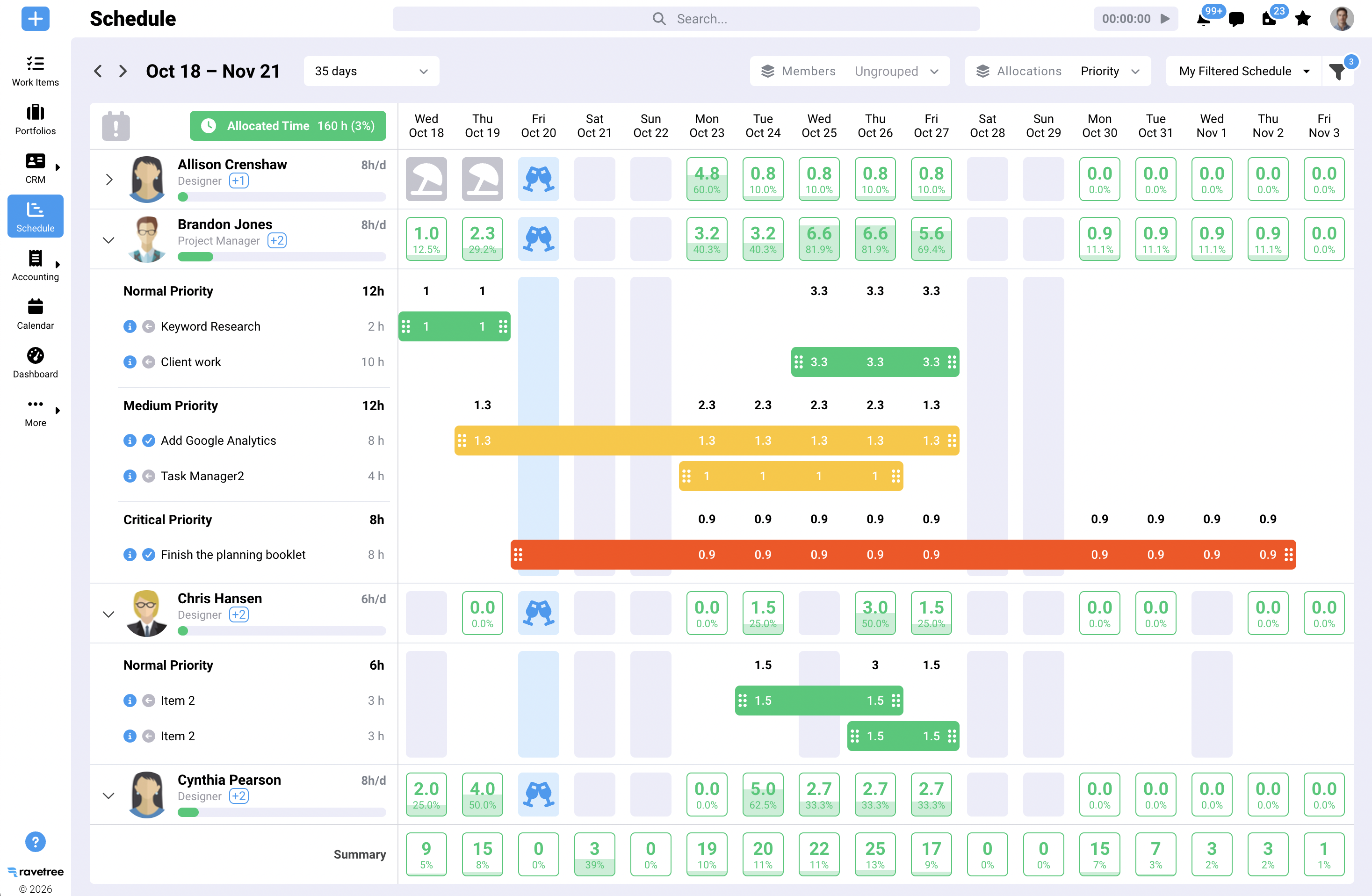
Ravetree shows utilization for each person in hours and as a percentage, and rolls it up by team, office, department, or the whole firm. Heat maps flag who's overallocated in upcoming weeks, so the reviewer shortfall from our October example shows up while there's still time to move work, rather than on October 12.
Tasks can be assigned to work roles instead of named people, and those soft allocations count against capacity. That's how you sketch next busy season by role in November. Ravetree also supports tentative bookings for pipeline work, so a new CAS client that's likely but not signed can appear in the forecast before anyone commits to a start date. Unscheduled tasks sit in their own queue, and you can drag them onto whoever has room; unassigned work still counts toward firm-wide demand, so it can't hide.
Availability that matches the real calendar
Two-way sync with Google Calendar and Outlook pulls meetings into availability automatically. Approved time off and holidays reduce capacity, and each person's workday and workweek can be customized. Part-time schedules, Friday business-development blocks, and post-April vacations all show up accurately without a side spreadsheet.
You can also set a target billable utilization rate for each employee and run reports against it, which is what turns point four above from a good intention into a weekly habit.
Capacity tied to the work and the invoice
This is where Ravetree pulls away from standalone schedulers. Project management, time tracking, retainers, and billing run in the same platform as the capacity plan, so planned hours, logged hours, and invoiced hours are never three different spreadsheets. The CRM and proposals sit upstream, which means the hours you estimate when scoping an advisory engagement can become the hours you staff. If you bring in contract preparers during busy season, purchase orders linked to vendors and expense tracking keep that spend attached to the projects it supports.
What customers tend to mention
Ravetree's positive reviews on Capterra return to a few themes. One accounting firm COO wrote that work that used to require several separate apps now lives in one place, while noting that the platform's breadth can feel like a lot at first and is easiest to adopt in stages. A project manager singled out the schedule page for showing team capacity in a single view, alongside time and budget tracking for judging client profitability. Responsive support and hands-on onboarding come up repeatedly, too. These are individual experiences, but they match what a capacity-strapped firm needs.
The honest limitation
Ravetree isn't tax preparation software. It won't replace your tax engine, and it doesn't include tax-specific tools such as IRS transcript retrieval. Most firms run it alongside their tax software as the operational layer for staffing, workflow, and billing. If you're weighing that split, Ravetree's guide to practice management software for accounting firms compares tax-centric suites with broader platforms, and its review of project management tools for CPAs looks at which revenue models suit which tool.
Using This Fall to Build Next Spring's Capacity Plan
The extension crunch you're in right now is the best calibration data you'll get all year. The AICPA's own guidance to small firms notes that managing seasonality remains a live challenge even when technology and tax complexity grab more attention. Here's a sequence that turns this October into a better March:
- Log the extension backlog by role, now. Record how many preparer hours and review hours the remaining extended returns actually take. Those ratios are your planning assumptions for spring.
- Define four or five roles, not twenty. Preparer, senior, reviewer, partner sign-off, and CAS lead covers most firms. Tag people with the skills that matter, such as multi-state, trusts, or partnership allocations.
- Connect calendars and load known time off. Get CPE blocks, planned PTO, and the post-April 15 vacations into the system before you forecast anything.
- Soft-allocate January through April by role. Use last season's volume, adjusted for clients you've added or lost. Look for weeks where review demand exceeds reviewer availability.
- Set utilization targets per person. Then agree, out loud, on what's acceptable in March and what isn't.
- Hold a 20-minute weekly capacity review starting the first week of January. Look at the heat map, move work, and escalate early. Short and frequent beats long and quarterly.
None of this requires new hires. It requires resource management software that shows the problem early enough to act on it.
Plan for the Next Cliff, Not the Current One
The staffing squeeze isn't a phase. In the same AICPA survey, staff retention made the five-year top-five list for every firm size except sole practitioners. The firms that get through the next few seasons in good shape won't necessarily be the ones that hire fastest. They'll be the ones that know, in November, which week in March their reviewers run out of hours.
That's the whole argument. Capacity in a CPA firm is seasonal, review-constrained, and dependent on client readiness, and a tool that treats it like a flat 40-hour week will keep surprising you. Ravetree handles role-based soft allocations, calendar-aware availability, per-person utilization targets, and the link from hours to invoices in one system, which is why it's our pick among resource management software for accounting firms. If you're evaluating capacity planning and resource management software for CPAs, run your current extension backlog through a trial and see whether the reviewer crunch shows up before October 15 does.
Frequently Asked Questions
What's the difference between capacity planning and resource management in a CPA firm?
Capacity planning estimates how many hours of each kind of work the firm can absorb in a given week. Resource management decides who does that work and adjusts as deadlines, client readiness, and availability change.
How far ahead should a CPA firm plan busy-season capacity?
Start in October or November. That's early enough to soft-allocate January through April by role, spot reviewer shortfalls, and line up contract help or adjust engagement start dates before other firms book the same people.
Can resource management software replace tax preparation software?
No. Resource management software runs staffing, workflow, time, and billing; your tax engine still prepares and files returns. Most firms run the two side by side.
What utilization target makes sense for CPA staff?
There isn't one number. Set targets per role, since partners carry business development and review while staff carry preparation, and judge results by week so busy-season overload and summer slack don't cancel each other out.