.png)
Key takeaways:
Professional services firms billed just 66.4% of available hours in 2025, the lowest average SPI Research has recorded. Take a moment to consider what that means. Roughly a third of the capacity you pay for goes unbilled, and most firms can't pinpoint exactly where those hours went.
That's the real case for staffing and resource allocation software for professional services. It's not about prettier Gantt charts or another dashboard. The purpose of resource allocation software is to put the right person on the right project before valuable hours go to waste and to identify capacity gaps while there's still time to address them.
I've managed project delivery at agencies and consulting firms long enough to see good businesses lose profit margins in the same ways, year after year. Below, I'll explain how that lost revenue happens, what staffing software needs to do for a professional services business, and why Ravetree is the platform I'd choose for firms that sell their time.
Staffing and Resource Allocation Are Two Different Jobs
Firms often use these terms interchangeably, but they describe two different responsibilities.
Staffing is the process of deciding who will work on an engagement: which consultant, at what skill level, and under which rate card. These decisions often happen early, sometimes before a contract is signed, and are heavily influenced by the sales pipeline.
Resource allocation is the ongoing process of determining how much of each person's available time should be assigned to different projects. It involves distributing hours across assignments based on each person's availability. Those allocations can change whenever a client moves a deadline, a project changes scope, or an employee calls in sick.
A common problem is managing staffing decisions from a partner's memory while tracking resource allocation in a spreadsheet. The two quickly fall out of sync. For example, staffing plans might promise a senior strategist for 20 hours a week, only for the resource allocation process to reveal that she's already committed to 38 hours elsewhere. By the time anyone catches the conflict, the project kickoff may already be scheduled.
Effective resource allocation software brings both responsibilities together in a single system of record. Staffing decisions become bookings, bookings consume available capacity, and that capacity remains visible to everyone responsible for making future staffing decisions.
Where Billable Utilization Actually Leaks
Billable utilization is the percentage of available working hours spent on billable work. The formula is simple, but the results can be troubling. SPI Research's 2025 benchmark showed that billable utilization had fallen to 68.9%, below the 75% level it considers optimal. The rate subsequently declined further.
In my experience, this decline isn't caused by consultants being lazy. Instead, it usually comes down to four specific problems.
The staffing spreadsheet is wrong by Wednesday
Most firms with fewer than 200 employees still rely on shared spreadsheets to manage staffing. They're flexible and free, but they can also create serious problems. Researcher Raymond Panko's field audits found that 88% of the 113 real-world spreadsheets audited since 1995 contained errors.
Staffing spreadsheets can be particularly problematic because they're rarely audited or updated consistently. They're also outdated almost as soon as they're saved. A spreadsheet won't automatically account for Tuesday's client workshop, Thursday's dentist appointment, or the three tasks that nobody has gotten around to assigning.
Your stars are overbooked while the bench sits idle
Every firm has a handful of people whom project managers request by name for nearly every engagement. Research published in Harvard Business Review found that just 3% to 5% of employees account for 20% to 35% of value-added collaborative work.
The result is often an uneven distribution of work. Your top performers may be working at 110% capacity while capable mid-level consultants remain at 50% utilization because nobody has checked whether they have the necessary skills. Both situations create problems. Overworked employees face burnout, while underutilized employees represent unnecessary labor costs.
Consider the financial impact of underutilization. A mid-level consultant billing $150 per hour who operates at 50% utilization instead of 70% leaves approximately 360 billable hours unused each year, assuming 1,800 available hours. That's $54,000 in potential revenue lost from a single employee. Many firms have several employees in the same situation.
Context switching eats the hours you do allocate
Assigning one consultant to five small engagements might look efficient in a resource allocation grid, but the reality can be quite different. The American Psychological Association notes that the mental blocks caused by switching between tasks can consume up to 40% of someone's productive time.
This means the quality of resource allocation matters just as much as the number of hours assigned. Two projects requiring 20 hours each will often be more manageable than five projects requiring eight hours each, even if the total weekly hours are similar.
Pipeline work arrives as a surprise
Sales closes a deal on Friday, but the delivery team doesn't hear about it until Monday. Without a way to account for tentative demand, every new project can become an emergency. The resulting scramble often forces employees to abandon or delay billable work already in progress.
This problem can become especially costly as a firm grows. PMI's Pulse of the Profession research has long identified inadequate resource forecasting as a contributor to project failure. Its 2016 report found that poor project performance wasted US$122 million for every US$1 billion invested.
What Resource Allocation Software Must Do for a Services Firm
Generic work management tools were designed primarily to track tasks. Professional services firms need something more specialized: a system that treats employee hours as inventory and expertise as a core business asset. When evaluating resource allocation software for a consulting firm, agency, or engineering practice, there are five capabilities I consider essential.
Availability that reflects the real calendar
A standard 40-hour workweek rarely reflects an employee's actual availability. Holidays, paid time off, part-time schedules, and client meetings all reduce the hours available for project work. If the software doesn't automatically account for these commitments, capacity estimates will be inflated, and every staffing decision will be based on inaccurate information.
Skills and seniority, not just names
Resource allocation software should let managers filter available employees by skills, experience level, role, office, and department. Simply asking, "Who's available?" isn't enough. Managers need to answer more specific questions, such as, "Which senior data engineer has 15 available hours in November?"
Soft bookings for pipeline demand
Tentative allocations for deals that haven't closed help firms identify future capacity shortages before they become urgent. They also provide valuable information for workforce planning. Instead of hiring in response to a staffing crisis, firms can make hiring decisions based on forecasts that show sustained demand exceeding available capacity.
Individual utilization targets
A practice lead shouldn't have the same billable utilization target as a junior analyst. Effective firms establish utilization targets for individual employees based on their roles and responsibilities, then measure actual performance against those targets. This ensures that a 60% utilization rate is evaluated in the proper context for each employee.
A direct line from hours to money
Resource allocation without actual time data is little more than an estimate. Planned hours need to connect directly to logged time, and logged time needs to flow into invoicing. Otherwise, firms end up maintaining two separate versions of their financial reality: the plan everyone relies on and the actual results that finance discovers at the end of the month.
This is where many standalone scheduling tools fall short. They may provide excellent scheduling views, but they often can't answer the question that matters most to a managing partner: Did those staffing and allocation decisions actually make us money?
How Ravetree Handles Staffing From Pipeline to Invoice
Ravetree was built as an all-in-one platform for professional services firms, so staffing isn't an add-on. It's integrated with project management, time tracking, and financial management. Here's how the process works throughout a typical client engagement.
Before the deal closes
An account manager is working on a six-month implementation deal in the CRM pipeline. A delivery manager creates a preliminary project plan and assigns tasks to work roles, such as "Senior Consultant" or "Solutions Architect," rather than assigning specific employees.
Ravetree treats these assignments as soft allocations, allowing them to appear in utilization forecasts before the project is officially confirmed.
If the forecast shows that your architects are already 90% booked for the first quarter, you can identify potential staffing problems early. You may need to negotiate a later project start date or bring in a contractor to meet the demand.
Project estimates can also come from proposals created using templates or previous projects. This helps ensure that the estimated hours used for project scoping align with the hours included in the staffing plan.
When the contract is signed
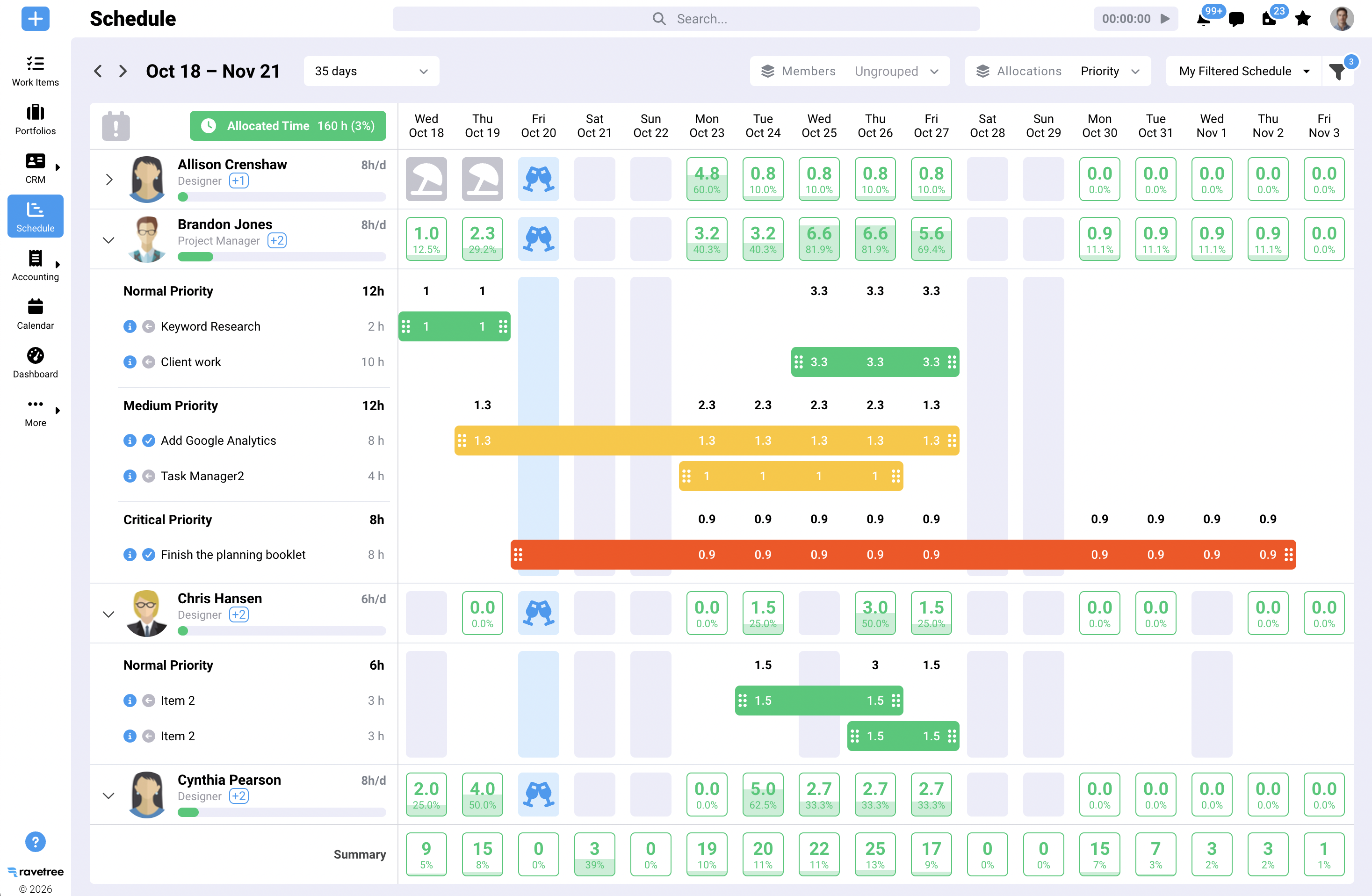
Once the contract is signed, soft allocations can be converted into assignments for specific employees. The resource planning view lets managers filter employees by skills, skill level, team, work role, office, or department. They can then compare assigned hours with each person's remaining capacity to determine who is available for the work.
Resource planning heat maps highlight employees who are overallocated in the coming weeks, giving managers time to address potential conflicts before they become urgent.
Unscheduled tasks appear in a separate queue, allowing managers to assign them to employees with available capacity. Even unassigned work counts toward company-wide capacity, making it easier to identify outstanding demand instead of overlooking it.
For creative agencies managing dozens of projects simultaneously, our guide to capacity planning for multi-project creative teams explores this workflow in greater detail.
While the work is running
Employee availability is based on actual calendar commitments rather than standard working hours alone. Two-way synchronization with Google Calendar and Outlook automatically imports meetings. For example, if a consultant has eight working hours available on a particular day and a two-hour client workshop, the system shows only six hours of remaining availability.
Approved time off, holidays, and customized workdays or workweeks also adjust available capacity automatically.
Consultants log their hours using time tracking, which is connected to the same tasks they were assigned. This allows managers to compare planned and actual hours for every assignment, making it easier to identify scope creep before it becomes a significant problem.
When it's time to bill
Because time tracking is integrated with the rest of the platform, recorded hours flow directly into billing. Ravetree identifies which clients have completed work ready for invoicing and manages retainers for recurring engagements.
The platform also connects expense tracking and purchase orders to projects, helping ensure that reimbursable expenses and other project costs aren't accidentally left off client invoices.
Clients can monitor project progress through a client portal. New work can also come through customizable request forms submitted by clients or internal teams. This ensures that incoming work is visible to the people responsible for staffing instead of getting buried in someone's inbox.
Measuring against targets
Managers can set individual billable utilization targets for every employee and report on performance by person, team, office, department, or the entire firm. Reports can display utilization in hours or percentages.
The result is a continuous cycle of planning, staffing, delivering, measuring, and adjusting. That feedback loop is what makes effective resource allocation possible.
Why an Integrated Platform Beats a Standalone Scheduler
There are plenty of standalone scheduling tools available, and we've compared several in our roundup of top tools for workload planning. However, for professional services firms, the ability to integrate scheduling with other business functions is often the deciding factor.
Consider what happens when a scheduling tool doesn't share data with time tracking. You can't easily compare planned hours with actual hours. Without that comparison, it's difficult to identify which staffing decisions are reducing profitability. And without that insight, the firm risks repeating the same allocation mistakes and remaining stuck at roughly 66% utilization.
The data also highlights the potential value of integration. SPI Research found that firms using professional services automation report roughly 10% higher billable utilization than firms relying on spreadsheets for staffing.
Consider a 50-person firm with 1,800 available hours per employee annually. Increasing utilization from 66.4% to 75% would generate approximately 7,740 additional billable hours per year. At a blended billing rate of $175 per hour, that's roughly $1.35 million in additional potential annual revenue.
That increase doesn't require hiring additional employees. Instead, it requires identifying unused capacity early enough to put those hours to work. For agencies evaluating their options, our guide to the best agency work and resource management platform outlines the key selection criteria.
The Trade-Offs Nobody Mentions in the Demo
It would be misleading to suggest that software alone can solve every staffing problem. Here are some practical challenges to consider before implementing a new system.
The system only knows what your people tell it
Planned-versus-actual reporting is only useful when employees record their time accurately and consistently. If consultants wait until Friday afternoon to reconstruct their entire week's activities from memory, the resulting data may be unreliable.
Before purchasing a resource allocation tool, establish clear expectations for time entry. Decide whether employees should record their hours daily or at least twice a week. The software can make time tracking easier, but it can't guarantee that employees will follow the process.
Chasing 100% utilization backfires
Higher utilization is an important goal, but maximizing it at all costs can create serious problems. Gallup reports that 76% of employees experience burnout at least sometimes, and that how employees experience their workload matters more than the number of hours they work. Burnout can contribute to employee turnover, and Gallup estimates that replacing an employee costs between one-half and two times their annual salary.
That's why individual utilization targets and forward-looking capacity heat maps are important. They help firms work toward a 75% utilization rate across the organization without consistently overloading their most valuable employees.
Consolidation takes real effort
Moving project management, time tracking, and billing into a single platform requires more effort than simply adding a scheduling plugin. You'll need to review and organize work roles, rate cards, and client records before migrating them.
Plan to dedicate two to four weeks of focused work from one employee to complete this cleanup. Don't simply assign the task to whoever happens to have available time. Ravetree includes a customized onboarding session at no additional cost, along with live chat and video support, which can make the transition easier.
Questions worth asking in any demo
Software vendors will naturally show you their most polished screens during a demo. To understand how a platform actually works, ask questions that reveal how it handles everyday staffing challenges.
- If I move a project start date by two weeks, what happens to all the allocations associated with it?
- Can I see which skills are likely to be overallocated next quarter, rather than just which employees are overbooked?
- How do calendar meetings and approved PTO affect employee availability?
- How can I compare planned hours with logged hours, and how quickly can I identify discrepancies?
- What steps are required to turn tracked time into a client invoice?
If the answers involve exporting data, manually reconciling spreadsheets, or relying on features that are still on the product roadmap, you'll have a clearer understanding of the platform's limitations.
Rolling It Out Without Wrecking Next Quarter
You don't need a six-month implementation to start seeing results. A phased rollout can help your team adopt the system without disrupting ongoing projects.
- Weeks 1–2: Define roles and skills. Create a standardized list of work roles, skills, and skill levels. Configure each employee's workdays, workweek, and billable utilization target.
- Weeks 2–3: Connect calendars and time off. Enable Google Calendar or Outlook synchronization and enter company holidays and approved PTO. This ensures that capacity forecasts reflect actual availability from the beginning.
- Weeks 3–4: Move active projects. Assign current project work to specific employees and begin recording time against those assignments.
- Month 2: Soft-book the pipeline. Add tentative allocations for deals that exceed a probability threshold agreed upon by the sales and delivery teams.
- Ongoing: Run a weekly staffing meeting using the heat map. Set aside 15 minutes each week to review capacity, resolve scheduling conflicts, and make staffing decisions based on current data rather than assumptions.
Once these basic processes are established, the next step is to get more value from the hours your team already has available. Our guide to improving resource utilization and maximizing billable hours covers strategies for improving utilization after your resource allocation system is in place.
Firms That Staff Earlier Bill More
The pattern in SPI Research's latest study, which covered 509 firms employing more than 245,000 consultants, is consistent. High-performing firms don't necessarily have better employees. They identify demand earlier, assign work based on skills rather than habit, and connect allocated hours to actual billing.
That's the central argument for staffing and resource allocation software for professional services: utilization is largely determined before the work begins, not after it's completed. Resource allocation software that connects the sales pipeline, employee calendars, skills, time tracking, and billing gives firms the visibility they need to make better staffing decisions.
Your next step is straightforward. Review last quarter's utilization by employee and identify anyone above 90% or below 55%. Then schedule a Ravetree demo and ask to see how those same employees would appear in the system with soft bookings and capacity heat maps.
Frequently Asked Questions
What does staffing software do for a professional services firm?
Staffing software helps professional services firms assign employees to projects based on their skills, availability, and business priorities. It can also connect staffing decisions to time tracking and billing, allowing managers to understand how resource allocation affects project profitability.
What is a good billable utilization rate?
SPI Research identifies 75% as the optimal billable utilization rate, while the 2025 industry average was 66.4%. However, utilization targets should vary by role. Senior leaders, for example, typically have lower billable targets than employees who spend most of their time delivering client work.
What is the difference between soft and hard bookings?
A soft booking is a tentative allocation of an employee's or work role's time to a project that hasn't been confirmed. A hard booking assigns a specific employee's hours to confirmed work. Using both allows firms to forecast capacity and anticipate hiring needs before deals are finalized.
Can Ravetree staff projects based on skills?
Yes. Ravetree allows managers to filter and assign employees based on their skills and skill levels, as well as their team, work role, office, and department.
Does Ravetree account for meetings and time off in availability?
Yes. Ravetree's two-way Google Calendar and Outlook integrations automatically incorporate meetings into availability calculations. Approved time off, holidays, and customized workweeks also reduce available hours.