
Key takeaways:
Your project management tool says every project is green. Your P&L says otherwise.
Here's why that happens. Professional services firms billed just 66.4% of available hours in 2025, the lowest utilization rate in the history of SPI Research's benchmark. Deadlines weren't the problem. Visibility was.
That gap is the real story behind work management vs project management software. Most agencies don't have a scheduling problem. They have a work management problem dressed up as one. Tasks get done and milestones get hit, but margin quietly leaks out between the timesheet, the invoice, and the client email nobody logged.
So which one do you actually need? If you sell time and expertise, the honest answer is both, running in one system. I've watched too many firms learn that the expensive way. Below is how the two categories really differ, what the gap costs, and how to tell which side of the line your firm sits on.
What Each Category Actually Manages
Sales demos use these labels interchangeably. They shouldn't. The difference comes down to scope: one manages a project, the other manages the business that runs the projects.
Project management software: the delivery layer
The Project Management Institute defines project management as applying knowledge, skills, tools, and techniques to project activities so they meet project requirements. That's a tight definition. It covers scope, deliverables, risk, and team communication.
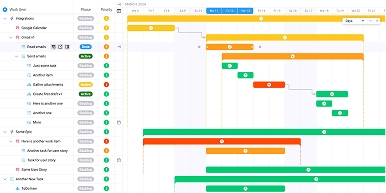
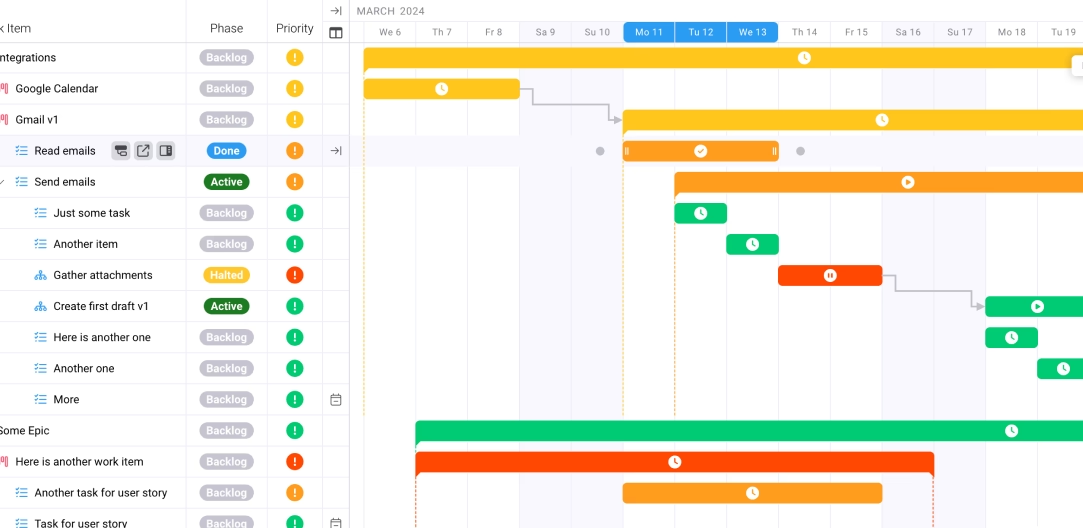
Project tools are built for exactly that job. You get tasks, dependencies, Gantt and Kanban views, milestones, file sharing, and status reports. A project starts, runs, and ends.
What these tools usually don't touch: who's selling the next project, what the client agreed to pay, which hours are billable, and whether the invoice actually went out.
Work management: the system that runs the whole operation
Gartner frames work management as software that applies workflow structure to how information moves between business processes and the people doing the work. Notice the scope. It isn't about one project. It's about how work flows across the entire company.
Gartner's evaluation of the adjacent collaborative work tools market lists planning, in-context collaboration, workflow automation, reporting, and dashboards running on a shared data and admin platform as defining capabilities. That shared data layer is the whole point.
For a client-service business, the platform has to go further. It needs to connect the full lead-to-cash lifecycle:
- CRM and sales pipeline
- Proposals and estimates
- Project delivery and task execution
- Time tracking against rates and budgets
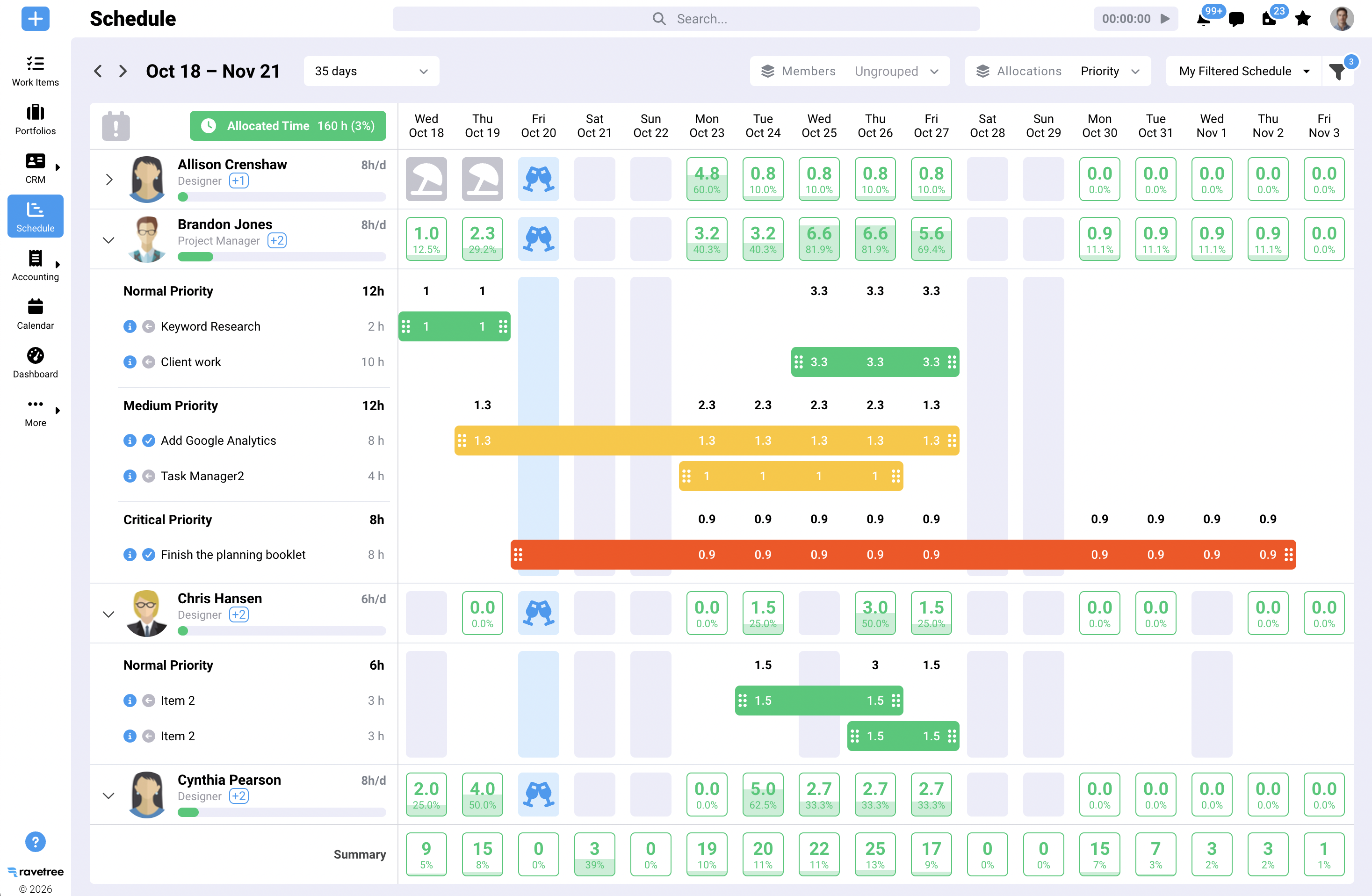
- Resource planning based on real capacity
- Billing and profitability reporting
One record, start to finish. Here's the simplest way to hold the distinction in your head. Project management tells you whether the website launch is on schedule. Work management tells you whether the website launch is making you money.
Side by Side: Where the Two Categories Split
Feature lists overlap more every year, so compare them based on the questions each system can answer. These seven criteria are the ones that decide whether a tool fits a services firm.
- Main question it answers
- Project management software: Is this project on track?
- Work management platform: Is the business on track?
- Scope
- Project management software: One project or a portfolio.
- Work management platform: The whole client lifecycle, from lead to cash.
- Core users
- Project management software: Project managers and delivery teams.
- Work management platform: PMs, account leads, finance, operations, and executives.
- Financial data
- Project management software: A budget field, maybe hours.
- Work management platform: Rates, billable hours, retainers, invoices, and margin.
- Client-facing tools
- Project management software: Usually none; email and shared links.
- Work management platform: Client portal, requests, and approvals.
- Capacity view
- Project management software: Who's assigned to which task.
- Work management platform: Availability and skills against pipeline demand.
- Typical outcome
- Project management software: Better on-time delivery.
- Work management platform: Better utilization, margin, and forecast accuracy.
The row that matters most is financial data. Project tools treat money as an afterthought, a budget field someone updates by hand at month end. Work management treats money as a first-class object, because in a services firm every hour is inventory. Unsold hours expire.
The client-facing row is a close second. When clients can't submit requests or approve deliverables in one place, your PMs become human routers. That costs hours nobody bills.
Why "just integrate it" rarely holds up
The usual counterargument: keep your favorite PM tool and connect it to a timer, a CRM, and accounting software. On paper, fine. In practice, every hand-off adds a sync delay, a field-mapping rule, and a new place for data to break.
Integrations also freeze your process. Change a rate card or a project code, and someone has to update three connectors. Ravetree's team makes the case directly in why project management alone isn't enough for service firms, and it matches what I've seen: the stitched stack works until the person who built it leaves.
What the Gap Actually Costs a Client-Service Firm
Running delivery in one tool and the money in four others doesn't look expensive. No single invoice says "fragmentation." The cost shows up in four places instead.
The toggle tax
A Harvard Business Review study of 137 users across three Fortune 500 companies found people switched between apps and websites roughly 1,200 times a day, losing just under four hours a week, about 9% of their working time, to reorienting after each switch.
Stitch together a PM tool, a timer, a CRM, a spreadsheet, and accounting software, and you've built that tax into every workday. The mental cost compounds, too. The American Psychological Association summarizes research showing task switching can consume as much as 40% of productive time.
Utilization that erodes before projects start
That record-low 66.4% utilization figure has a cause. Analysts reviewing the 2026 SPI benchmark note that utilization problems usually begin before a project kicks off, because sales sees demand building before delivery can plan staff for it.
A standalone PM tool can't see the pipeline. So you find out you're overbooked, or idle, after it's too late to fix cheaply.
Run the math on your own team. Take 20 people at $150 an hour with 1,800 available hours each. One point of utilization equals 360 hours, or $54,000 in annual revenue. Five points is $270,000.
Margin that leaks through the seams
Poor execution has a measurable price. PMI found organizations lost 9.4% of project investment to poor performance such as missed deadlines, overrun budgets, and scope creep. In agencies, scope creep hits twice: once in hours burned, and again when those hours never reach an invoice.
Unlogged time. Unbilled change orders. Expenses nobody passed through. None of it appears on a project dashboard. It appears at quarter end, when finance asks why revenue rose and profit didn't. This breakdown of how CFOs drive business value from a single platform walks through the finance side in detail.
Software you pay for but don't fully use
Zylo's 2026 SaaS Management Index found organizations manage about 305 applications and add nearly nine new ones every month. The same research found companies leave an average of 36% of SaaS licenses unused.
Five point solutions means five renewals, five admin consoles, and five seat counts drifting out of sync. Consolidation cuts spend, but the bigger payoff is one source of truth.
When a Project Tool Is Enough, and When You've Outgrown It
Let's be fair. Plenty of teams don't need anything more than a solid project tool. Buying a bigger platform than you need creates its own friction.
A project tool is probably enough if:
- You're an internal team (IT, product, marketing ops) with no client billing
- Finance lives in a separate department and nobody needs project-level profit
- Projects are the only unit of work you track
- You're under about 10 people, and one founder holds the full picture in their head
You've outgrown it if:
- PMs rebuild timesheets in spreadsheets before billing clients
- Account leads can't see hours burned against a retainer without asking someone
- Resource conflicts surface in stand-ups instead of in a capacity plan
- Proposals get priced on gut feel because nobody can pull actuals from similar past work
- Client asks arrive through five inboxes instead of one intake point
- You've bolted on separate tools for purchase orders or expense tracking
If three or more items on the second list sound familiar, the tool isn't failing because it's bad. It's failing because it was never designed to run a services business.
One more signal worth watching: who owns the "real" numbers. When your ops lead keeps a private spreadsheet that everyone trusts more than the official dashboard, the system of record has already moved. It just moved somewhere fragile.
Why Ravetree Is the Work Management Platform Service Firms Should Shortlist
Here's my position, and I'll own it. For agencies, consultancies, and professional services teams, Ravetree is an outstanding full-featured work management platform, and its project management features hold their own against best-in-class dedicated PM tools. You don't have to trade depth for breadth.
That trade-off is the trap most all-in-one systems fall into. They start as accounting or CRM products, then bolt on a thin task list. PMs hate them within a month and quietly go back to their old tool. Ravetree avoids that by treating delivery as a first-class workflow.
Project management your PMs won't want to escape
Tasks, subtasks, dependencies, Gantt and Kanban views, templates, milestones, and workflow automation. The delivery toolkit your team expects is all there. The difference is what sits underneath: every task connects to a budget, a rate, logged time, and a client record.
The rest of the business, in the same system
- CRM and pipeline data that feed forecasts into resource planning
- Proposals that convert into projects without re-keying scope
- Time tracking tied to billable rates and project budgets
- Retainer management that shows burn in real time
- Invoicing generated from approved time and expenses
- Purchase orders and expense tracking measured against project budgets
- Client portals and request intake, so clients stop emailing your PMs directly
If billable hours drive your revenue, this guide to work management software with billable hours tracking explains why it matters where time lives. The broader argument for an all-in-one platform for client-service businesses lays out the operational math.
What this looks like on a Thursday afternoon
A client asks for a rush add-on. In a PM-only stack, the PM adds tasks, pings finance on Slack, and the extra hours may or may not get billed 30 days later.
In Ravetree, the ask comes in through the client portal. It becomes a tracked change against the retainer, gets staffed from the resource plan, and the hours flow straight onto the next invoice. Same work. Very different margin.
Six Questions to Ask Any Vendor Before You Sign
Demos are designed to impress. These questions are designed to expose gaps. Ask them of every platform on your shortlist, and make the vendor show you, not tell you.
- Walk me through one billable hour from log to paid invoice. Count the screens and the hand-offs. Every manual step is a place revenue slips.
- Can the resource plan see the sales pipeline? If capacity planning only knows about signed work, you'll keep hiring late and benching early.
- How do retainers and change orders get tracked? You want burn visible to account leads daily, not reconciled by finance monthly.
- What does the client actually see? A real portal cuts status-update emails and speeds approvals. A shared link to a task board doesn't.
- Which tools does this replace, specifically? Get a written list. If the answer is "it integrates with everything," you're buying another layer, not a replacement.
- Will my PMs choose to use it? Put your most demanding project lead in the trial. If they won't live in it daily, nothing else matters.
If vendor spend runs through your projects, add a seventh: how are commitments approved before costs hit the budget? This look at choosing project software that handles purchase orders covers what good looks like.
Buy for the Business, Not the Gantt Chart
Project tools are good at what they do. The problem is what they don't see: the pipeline, the rate card, the retainer balance, the unbilled hour. For a firm that sells time, those blind spots are where profit disappears.
So start with an audit, not a demo. Pick one recent project and trace every hour from proposal to paid invoice. Count the tools it touched and the places someone re-typed data. That number tells you what fragmentation is costing you.
Then shortlist platforms that can run the whole lifecycle without watering down delivery. For service firms, that's the honest resolution of the work management vs project management software debate: you shouldn't have to choose. Pick work management that includes best-in-class project management, and your delivery wins finally start showing up in your margin.
Frequently Asked Questions
What is the main difference between work management and project management software?
Project management software plans and tracks individual projects: tasks, timelines, and deliverables. Work management covers the whole operation around those projects, including sales, resourcing, time, billing, and profitability, in one connected system.
Is work management software only for large enterprises?
No. Service firms with as few as 10 to 15 billable people often feel the pain first, because one missed invoice or one overbooked designer hits a small P&L hard.
Can I keep my project management tool and add integrations instead?
You can, but each integration adds sync delays, mapping rules, and upkeep. Most service firms find a unified platform cheaper to run and more reliable to report from.
What should agencies look for in a work management platform?
Focus on connected time tracking and billing, retainer visibility, resource planning linked to the sales pipeline, a client portal, and project management depth your PMs will actually use.
Does Ravetree include full project management features?
Yes. Ravetree pairs best-in-class project management, including tasks, dependencies, Gantt and Kanban views, and templates, with CRM, time tracking, resource planning, billing, and client portals on one platform.