
Key takeaways:
- Small digital agencies run two stacks: keep the delivery tools specialized, and consolidate the operations side into one system.
- Many clients on $1,000 to $10,000 retainers means thin margins per account, so per-client, per-month visibility matters more at small agencies, not less.
- Time data is a pricing tool for retainer businesses, and it's the only way to know whether AI-driven time savings become margin or free extra work.
- Ravetree combines retainers, time tracking, outside costs, CRM, proposals, client portals, and invoicing at a price a 10-person agency can carry.
It's the first Monday of the month at an 11-person digital agency. The reporting platform has already sent 24 client dashboards. Rankings are up, paid search looks healthy, and two clients replied with a thumbs-up before 9 a.m. Then the founder asks a simpler question: which of those 24 retainers actually made money last month? Nobody can answer without a spreadsheet and a lost afternoon.
That question is the real test for any list of the Best Software for Small Digital Marketing Agencies. Most shops already own plenty of marketing tools. What they're missing is software for small digital marketing agencies that runs the business behind the campaigns: the hours, the freelancers, the scope, and the invoice. This guide looks at what a small digital agency's numbers actually look like, what the operational side has to handle, where the usual setups break, and why Ravetree is the one we'd choose.
Your agency runs two software stacks, and only one of them is a mess
Every digital agency runs two stacks, whether or not anyone has drawn the line between them.
The delivery stack is what you use to do client work: ad platforms, analytics, SEO crawlers and rank trackers, social schedulers, email tools, and the reporting dashboard that bundles results for clients. The operations stack is what you use to run the agency itself. Who's working on what, how many hours each client consumed, what you owe the freelance writer, and what goes on the invoice.
The delivery stack gets the attention, partly because there's so much of it. Scott Brinker's annual martech map counted 15,384 marketing technology products in 2025, roughly 100 times as many as the first edition listed in 2011. Small agencies also spread across more channels than they used to. In AgencyAnalytics' 2025 benchmarks survey of more than 220 agency leaders, paid advertising was offered by 89% of agencies and had overtaken SEO and web design as the most widely provided service. Every channel brings its own platform.
Here's the distinction that should shape every software decision you make: the delivery stack should stay specialized, and the operations stack shouldn't. Your PPC lead needs the native ad tools. Your SEO lead needs a real crawler. Nobody should try to replace those with an all-purpose app. Operations is different. Spread it across a task board, a timer, a shared drive of freelancer invoices, and an invoicing app, and you create gaps that a nine-person team has no spare hours to reconcile. (Ravetree has written separately about judging consolidation by the handoffs it removes; the point here is narrower and specific to digital shops.)
A common mistake is stretching the delivery stack to cover operations, usually by treating the reporting tool's client view as a project tracker. That confuses two different facts. "The client can see results" is one. "We know what those results cost us" is another. The same AgencyAnalytics survey found 70% of agency leaders say client reporting plays a critical role in retention, and they're right. But a client can love the monthly report and still be your least profitable account. In practice, the happiest clients can be the most overserviced ones, precisely because they're getting more than they pay for.
What a small digital agency's numbers actually look like
The 2025 State of Digital Agencies survey from SparkToro and Paddy Moogan is useful because its sample looks like the reader of this article. Of 376 respondents, just over 84% were solo consultants or agencies of up to 25 people, and the most common services were SEO (81%), content strategy (74%), and paid search (62%).
The survey's follow-up on client services and operations fills in the business model. 85% of agencies prefer to work on retainers, up from 81% in 2024, and the rest of that data is just as telling:
- Nearly half (49%) report an average monthly retainer between $1,000 and $5,000, and another 31% sit between $5,000 and $10,000.
- Nearly a third say they've increased the number of freelancers and contractors they work with over the past year.
- Only 57% have their team record timesheets, and the smaller the agency, the less likely it is.
- Dedicated account managers show up consistently only at agencies above 50 people.
Put those together and you get a specific operating shape: lots of clients, modest recurring fees, part of the delivery done by people who aren't on payroll, and often no account manager standing between the work and the founder. An agency averaging $3,000 a month per client needs 25 clients to reach $900,000 a year. That's 25 renewals to protect, 25 monthly scopes to police, and 25 sets of outside costs to allocate.
That's a very different problem from a 20-person creative studio running six large fixed-fee projects, and it's why a lot of advice about software for small digital marketing agencies misses the mark. It borrows assumptions from shops that look nothing like yours.
Small retainers leave less room for error, not more
There's a comfortable assumption that small agencies with small clients can get by on lighter tools. The arithmetic points the other way.
Take a $3,000 monthly SEO and content retainer scoped at 20 hours, which works out to $150 an hour. Now add four unplanned hours in a month: one extra round of edits on a blog post, a "quick" tag manager check, and a call that was supposed to take 20 minutes and ran to 45. The effective rate drops to $125. That's 20% of the scoped time given away without anyone deciding to give it away. On a $30,000 retainer, the same four hours would barely register.
Multiply it across the book. Four unplanned hours on each of 25 clients is 100 hours a month, most of one full-time person's capacity, delivered free. (These are illustrative numbers. Plug in your own; the shape rarely changes.)
No single overage looks like a problem, which is exactly why the total goes unnoticed. Small digital agencies need per-client, per-month visibility more than large agencies do, not less: the margin of error on each client is thinner, and there are more clients to watch.
Costs behave the same way. When a freelance copywriter bills $600 for a client's four blog posts and the invoice goes straight to the bookkeeper, that client looks more profitable in every report you run. With so many agencies leaning harder on contractors, the blind spot is getting larger every year.
"We don't track time" works until the renewal conversation
Roughly four in ten agencies in the SparkToro data don't keep timesheets, and smaller shops are the least likely to. It's easy to see why. On a retainer, you don't need hours to send the invoice. The fee is the fee.
But for a retainer business, hours were never mainly about billing. They're about pricing. When a client renews, asks to add a channel, or pushes back on an increase, the only honest answer comes from how many hours their account actually consumed, by whom, and at what cost. Without that, renewal pricing is a guess, and guesses tend to drift toward keeping the client comfortable.
AI makes this sharper. AgencyAnalytics' 2026 report, based on 494 agency professionals surveyed between February and April 2026, found that 79% of agencies save five or more hours a week using AI. Saved hours only turn into margin if you can see where they went. Otherwise they get reabsorbed into extra deliverables and longer calls, and the agency ends up busier for the same money. Light time capture is how you find out whether the efficiency gain belongs to you or to the client.
Keep it light, though. Log from the task you're working on, daily, in 15-minute increments. Nobody at a 10-person agency should spend Friday afternoon reconstructing the week.
Six jobs the operations software has to do in a small digital shop
Feature lists won't separate the options. Jobs will. Here's what software for small digital marketing agencies has to handle when the book of business looks like the one above:
- Treat each retainer month as its own budget. A retainer isn't one long project. It's a series of monthly allotments, each with its own hours, its own overages, and sometimes its own rollover. The software should show where this month's allotment stands for every client on one screen, not after month-end.
- Put outside costs on the right client. Freelancer bills, stock assets, paid tools bought for one account. If those can't attach to a client and project, your margin reports describe a business you don't run.
- Give "quick asks" a front door. Most scope creep in digital work arrives as small, reasonable requests in email or Slack. Structured requests turn them into logged, estimable items someone can say yes, no, or "that's extra" to.
- Make time tracking nearly effortless. If logging an hour takes more than a few clicks, a nine-person team will stop doing it by week three, and every number downstream turns into fiction.
- Show capacity across many small accounts. With 25 clients and nine people, the hard question isn't one project's timeline. It's whether the content writer can take on two more clients in March. That's a resource planning question, and spreadsheets answer it badly.
- Fit a team without an operations department. Per-seat cost matters, but so does setup. If the platform needs a consultant and a quarter to configure, a small agency won't finish implementing it.
Notice what's missing from that list: dashboards for ad performance, keyword tracking, social scheduling. Those belong in the delivery stack, and they're probably handled well already.
Where the usual options fall short
Most small agencies end up in one of three places, and each one solves part of the problem.
A generic task board. Popular project management software and similar work management tools are good at assigning work and showing what's late. They're weaker on the money side: retainer allotments, cost rates, freelancer bills, and invoices usually live elsewhere. That gap is the core difference Ravetree covers in its comparison of agency management software vs project management software, so there's no need to rehash it here. For digital shops specifically, the pain shows up as 25 boards that each look fine and a profit picture nobody can assemble.
The reporting platform. Excellent at showing clients results. Not designed to show you what those results cost. Keep it, but don't ask it to be your operating system.
An enterprise PSA suite. Professional services automation platforms connect delivery and finance, and the heavier ones are very capable. For a ten-person digital agency, the problem is usually weight: long implementations and configuration built for firms with a full-time operations lead. Ravetree's look at PSA software for creative agencies covers that category in more depth. The short version for small digital shops: buy the depth you'll actually configure.
Why Ravetree is the best fit for a small digital marketing agency
Ravetree is an all-in-one platform for client-service businesses, and it lines up with the six jobs above more closely than any other software for small digital marketing agencies we've evaluated.
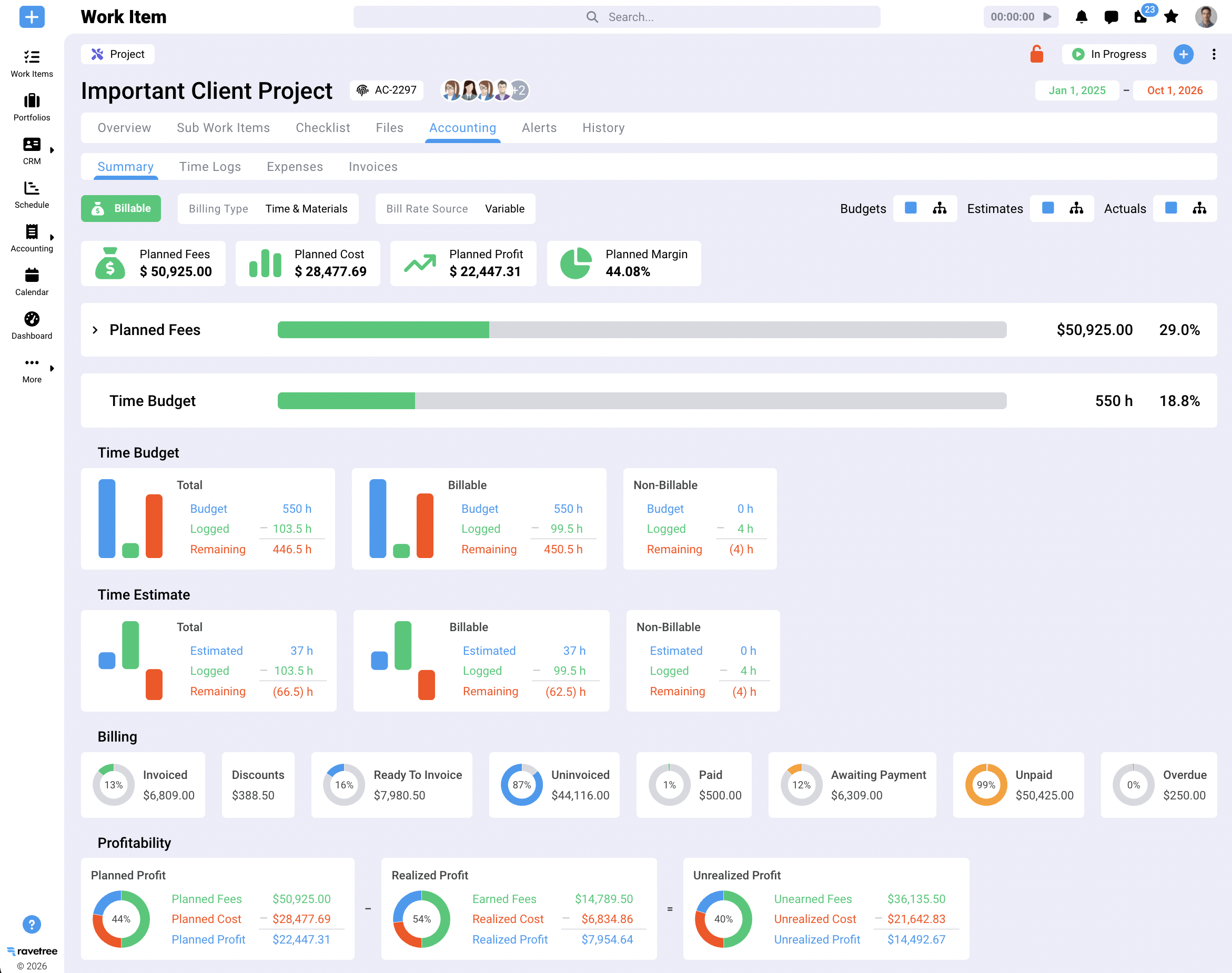
Retainers and per-client money. Retainers are tracked alongside the delivery work, so you can see how much of each client's monthly allotment has been used while the month is still running. Client-specific rate cards carry start and end dates, so a rate increase that starts in January applies to January's work, and several people can share one task with their own role, bill rate, and estimate. That matters in digital work, where a strategist, a writer, and a paid media specialist often touch the same monthly deliverable.
Outside costs where they belong. Expense tracking ties costs to projects and billing, and purchase orders link to vendors in the built-in CRM. The freelancer's $600 invoice lands on the client it belongs to.
From pitch to delivery to invoice. Proposals start from templates or past projects, and when a deal is marked won in the CRM, Ravetree can build the project from a template automatically. Project management covers Gantt and kanban views, Agile and traditional work, and nesting of tasks under projects under clients. Approved time and expenses flow into billing, and a client portal gives clients live status and files without your team forwarding emails.
Price and connections. Ravetree's G2 listing shows pricing of $39 per user per month, or $348 per user per year on annual billing. For a nine-person agency on annual billing, that's $3,132 a year. It also doesn't try to replace your books: its SourceForge profile lists integrations with QuickBooks Online, Xero, Stripe, HubSpot, Google Drive, and Outlook, plus an open API and a free trial.
What reviewers in marketing roles point to
Positive reviews on Capterra from people in marketing and advertising return to a few themes. Day-to-day staff describe small things that keep time data honest: a paid media intern liked nesting work items under projects under clients to manage a full schedule, a social media coordinator logs time straight from the kanban board, and a copywriter values seeing billable and non-billable hours each day. On the operations side, a head of operations at an agency that had tried both large all-in-one systems and a pile of small apps said the Ravetree team made changes during implementation so they could fully leave their previous platform. A senior project manager at a marketing firm that switched recently singled out fast support and a smooth onboarding. On SourceForge, the president and COO of a company with fewer than 25 people reported noticeably better internal adoption after moving off three previous tools.
Those are individual experiences, not guarantees, but the pattern is consistent: people tend to mention adoption and support as often as features.
Where it asks something of you
An integrated platform takes more setup than a single-purpose timer. One longtime reviewer noted that because Ravetree does so much, it's best learned gradually rather than all at once. That's sound advice for a small team. Start with clients, rate cards, retainers, and time. Add portals and resourcing once the hours are clean.
You'll also keep your delivery stack. Ravetree doesn't replace your ad platforms, SEO tools, or the reporting dashboard clients love. It runs the business those tools serve.
How a 10-person agency can switch in a month
You don't need a big-bang migration. A sequence that fits a small team:
- Week one: set up active clients, rate cards, and each retainer's monthly allotment. Leave closed work in the old tools.
- Week two: turn on time logging from tasks and route new client asks through request forms.
- Week three: attach freelancer and tool costs to clients, and send the first month's invoices from the new system.
- Week four: compare each client's hours against its allotment, and flag the three accounts furthest over.
That last step is where the payoff starts, and it's often where the surprise is: the account everyone calls easy can turn out to be the one running furthest over. If you're planning to grow past 15 or 20 people, Ravetree's guide to choosing an agency management system for a 15 to 50 person marketing team covers what changes at that stage.
Pick the stack that can answer the Monday question
Small digital agencies don't need more marketing software. They need one system that can say, for each of 25 modest retainers, how many hours went in, what the freelancers cost, and whether the fee still makes sense. Keep the delivery tools specialized and consolidate the operations side. Then run one month of real client data through a trial and see whether the profit picture finally adds up.
When you weigh the Best Software for Small Digital Marketing Agencies against that test, the deciding factor is retainer-level visibility, not the length of a feature list. For most small digital shops, that answer is Ravetree.
Frequently Asked Questions
Do small digital agencies need agency management software if they already use a reporting platform?
Yes, if they bill on retainers. A reporting platform shows clients what their campaigns achieved; it doesn't show you the hours, freelancer costs, and overages behind each account, which is what decides whether a retainer is profitable.
What should a 5-to-15-person SEO or PPC agency look for first?
Per-client, per-month retainer tracking and time capture that takes seconds. Those two features answer the renewal and pricing questions that matter most when you have many clients on modest fees.
How much does Ravetree cost for a small agency?
Ravetree lists $39 per user per month, or $348 per user per year on annual billing, with a free trial. A nine-person team on annual billing would pay about $3,132 a year.
Can software for small digital marketing agencies replace ad platforms and SEO tools?
It shouldn't try. Keep specialized delivery tools for campaigns and use an integrated platform like Ravetree for the operations side: time, retainers, outside costs, requests, and invoices.