
Key takeaways:
- Judge PSA software by weight: setup time, weekly admin hours, daily entry time per consultant, total cost at 50 seats, and the number of places the same data lives.
- Five extra minutes of daily admin across 30 consultants adds up to roughly 575 hours a year, about a third of a billable person.
- Buy for 50 people but switch features on only when a specific problem calls for them.
- Ravetree is our pick for 10 to 50 person consultancies because it covers the full engagement under one plan and reviewers consistently describe strong adoption and responsive onboarding.
At 12 people, a consultancy can run on the managing partner's memory. She knows who's free next week and which fixed-fee project is running hot. At 30 people, that memory fails, usually all at once.
If you're searching for the Best Lightweight PSA Tool for 10 to 50 Person Consultancy teams, the useful question isn't which product does the most. It's which lightweight PSA tool your firm can actually carry: set up without hiring an implementation partner, run without a full-time administrator, and use every day without senior consultants resenting their timesheets.
Professional services automation (PSA) software connects the sales pipeline, staffing, project delivery, time and expenses, and billing in one system. Most buying guides grade PSA platforms on capability. This one grades them on weight, meaning the ongoing effort it takes to keep the system accurate, because at your size that's what decides whether the software sticks or quietly gets abandoned for a spreadsheet.
Our pick is Ravetree. Below is the reasoning, the tests to run during a trial, and the situations where it isn't the right answer.
What "Lightweight" Should Mean (It Isn't Fewer Features)
Most people hear "lightweight" and picture a stripped-down product. That's the wrong mental model. A PSA platform that can't handle retainers isn't light. It just moves the weight into a spreadsheet that someone has to maintain on the last Friday of every month.
A better definition: a lightweight PSA tool is one where the effort to keep the system true stays small as the firm grows. That effort shows up in five places, and you can measure each of them during a trial.
- Setup weight. The time between signing and sending your first invoice from the new system. For a 10 to 50 person firm, that should be measured in weeks, not quarters.
- Admin weight. The hours each week someone spends maintaining rate cards, roles, templates, and permissions. A rule of thumb worth holding vendors to: under two hours a week at 30 people.
- Entry weight. What the system asks of each consultant every day, mostly through time tracking.
- Cost weight. Price at today's headcount, price at 50, and whether the capabilities you'll need at 40 sit behind a higher tier.
- Data weight. How many places the same fact lives. Every duplicate (a bill rate in the proposal tool and again in accounting, say) is a future reconciliation job.
Entry weight deserves a closer look, because it's the one buyers underestimate. Suppose a clunky tool adds five minutes a day to each consultant's admin. Across 30 people and roughly 230 working days, that's 575 hours a year. At 1,800 available hours per consultant, you've quietly given away about a third of a billable person. Nobody will ever see that number on a P&L, which is exactly why it matters.
Feature count is a weak proxy for any of this. Pendo's analysis of usage data across 615 software subscriptions found that about 80% of features in the average product are rarely or never used, while roughly 12% of features generate 80% of daily usage. The lesson for a consulting firm isn't "buy less software." It's that the dozen things your team does daily (log time, check a budget, see who's free, approve an invoice) need to be fast, and everything else should stay out of the way until you ask for it.
Unused features cost nothing. Unused features that add required fields, extra menus, and mandatory setup steps cost a great deal.
Why 10 to 50 People Is Its Own Buying Problem
Small firms don't get more complicated in a straight line. They get more complicated in steps, and simple arithmetic explains why. The number of possible one-to-one working relationships in a group is n(n−1)/2. A 10-person firm has 45. A 25-person firm has 300. A 50-person firm has 1,225. The hallway conversations and quick messages that coordinated a team of ten can't cover twenty-seven times as many connections.
In practice, firms in this band pass through three stages, and each one asks something different of the software.
10 to 20 people: the partner is the system
Staffing lives in one person's head, and it mostly works. The pain is financial: hours that never reach a client bill, fixed-fee projects that overrun without anyone noticing until the end, and a month-end close that eats a partner's weekend. You need projects with budgets, time capture, and invoicing. You don't need a skills matrix.
20 to 35 people: the first collisions
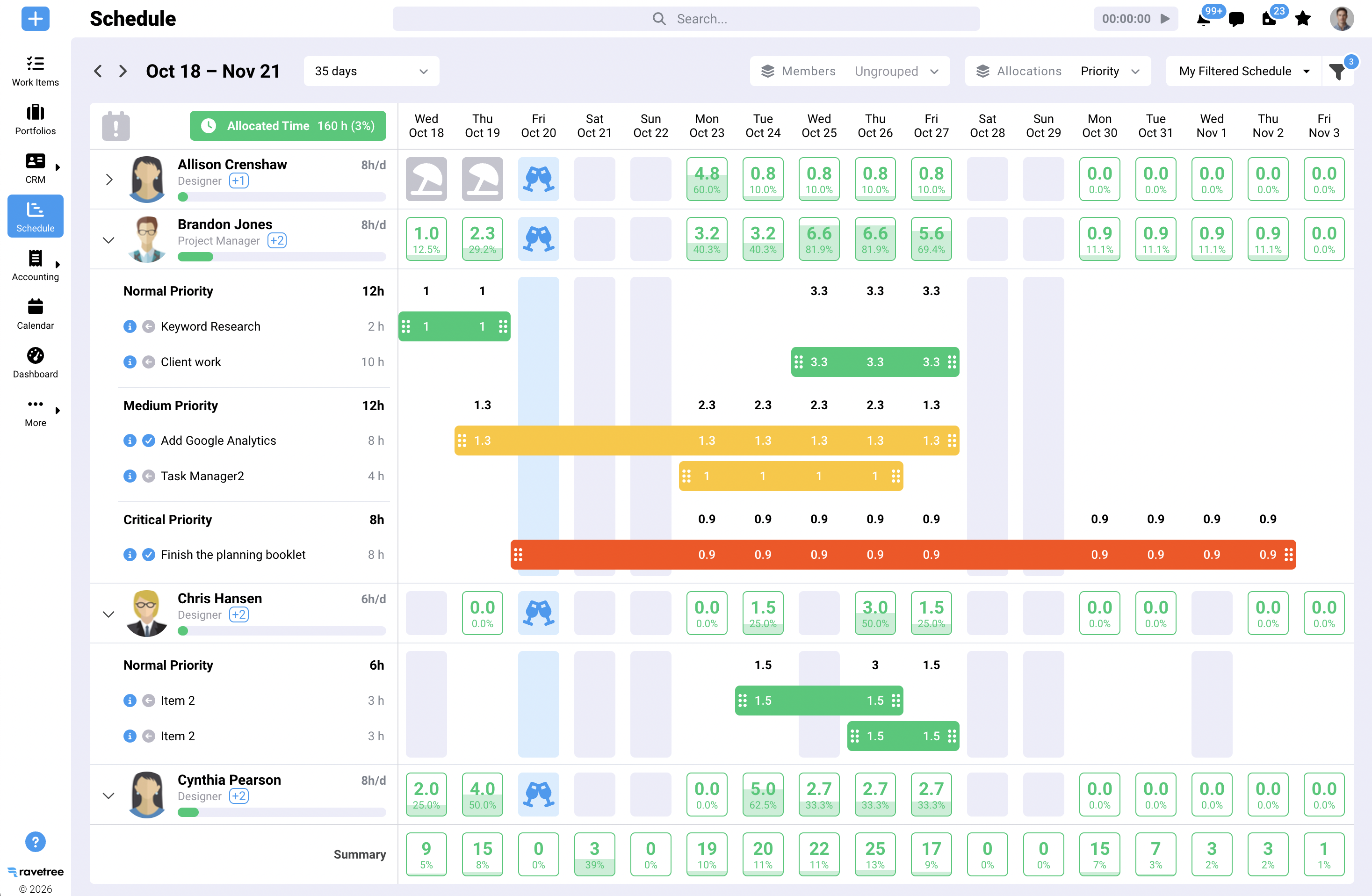
This is where the first layer of engagement managers appears, along with the first staffing collisions. Two partners promise the same senior consultant to two clients for the same week. One client has a monthly advisory retainer and a fixed-fee diagnostic drawing on the same people, and nobody can say which hours belong where. Shared resource planning stops being optional, and so does the ability to run fixed-fee, time-and-materials, and retainer work side by side. Ravetree has written about planning consulting capacity around your scarcest role rather than total headcount, and this is the stage where that advice starts to bite.
35 to 50 people: the first operations hire
Somewhere in here, you hire a part-time controller or an operations coordinator. That person will end up owning the system, and they're a generalist, not a certified administrator. If changing a workflow takes a specialist, the specialist becomes a recurring vendor invoice. Client volume also climbs enough that a client portal and structured intake through requests start paying for themselves in fewer status emails.
The buying lesson is simple, and most firms get it backwards: buy for 50, configure for where you are. A good lightweight PSA tool grows by switching capabilities on, not by forcing a migration to a bigger product. Every migration costs at least one messy billing cycle and a fresh round of retraining, and a firm that buys a starter tool at 15 people usually pays that bill again at 30.
There's a broader cost to getting this wrong. A Gartner survey of 4,861 employees found that 47% of digital workers struggle to find the information or data they need to do their jobs, and the firm tied the problem to a habit of answering every need with another application. That sample came from organizations with 100 or more employees, so treat it as directional for smaller firms. Still, a 30-person consultancy has the same problem in miniature, with no IT department to absorb it.
Two Ways to Get the Weight Wrong
Too light: a stack of simple tools
The usual starting point is a board-style project management app, a separate timer, a staffing spreadsheet, and invoices built in the accounting package. Each piece is easy to learn. That's the trap. Light tools add up to a heavy system, because the weight moves into the seams: the Friday export, the Monday reconciliation, the partner re-keying a signed quote into a project plan.
Generic work management tools are good at answering "is the task done?" They aren't built to answer "was it in scope, who's free for the next one, and did the hours reach a bill?" Ravetree's piece on running a consulting firm's operations from one platform tallies what that kind of stack costs, so there's no need to repeat it here.
One point is worth adding, though. Every extra tool brings its own notifications. Microsoft's telemetry from Microsoft 365 found that heavy users are interrupted roughly every two minutes during core hours by a meeting, email, or chat, which works out to 275 pings a day. That figure reflects the top 20% of users by message volume, a group that, in most consultancies, includes every partner. Adding two more apps that each want attention isn't a neutral decision.
Too heavy: an enterprise suite with no one to run it
At the other end sit PSA suites built for firms with revenue operations teams and dedicated system administrators. They're capable products. They fail at 30-person firms for a mundane reason: nobody's job is to feed them.
So the job lands on whoever is most organized, which usually means a senior consultant with a high billing rate. Four hours a week of system upkeep at a $200 blended rate, across 48 working weeks, is $38,400 of billable capacity spent on administration. That's more than the annual license fee for many tools in this category, and it never shows up on the software invoice.
A Two-Week Weigh-In: Seven Tests to Run in Any Trial
Demos are rehearsed. Trials aren't, if you run them properly. Load one real engagement, invite people who weren't on the sales call, and measure.
- The timesheet test. Ask three consultants to log a real week and time them. Under two minutes a day per person is good. Over five, and you've found your 575 hours.
- The Tuesday-afternoon test. Have the person who'll own the system change a bill rate and add a new role without contacting support. If it takes a ticket, admin weight is too high.
- The quote-to-project test. Build an estimate in proposals from a past engagement, mark it won, and check whether it becomes a budgeted project without retyping a single line.
- The subcontractor test. Raise one of your purchase orders for a specialist and log a client-site travel cost through expense tracking. Both should appear on the right client's draft invoice.
- The retainer test. Set up a 40-hour monthly retainer, log 34 hours against it, and see whether anyone gets warned before hour 40.
- The new-hire test. Give a login to someone who skipped the demo. Can they find their assignments and log time on day one without a walkthrough?
- The seat-math test. Price the platform at today's headcount and at 50, including every capability you expect to use by then. Get it in writing.
Pass all seven, and you've found a genuinely lightweight PSA tool. Fail two or more, and the weight is still there. It's just waiting until after you sign.
Why Ravetree Is the Lightweight PSA Tool We'd Pick
Ravetree is an all-in-one platform for client service firms, and for consultancies between 10 and 50 people it does well on every kind of weight described above. Here's the case, one weight at a time.
Cost weight. Ravetree sells a single plan rather than tiers that lock billing or staffing behind an upgrade. SourceForge lists pricing starting at $29 per user per month on annual billing ($348 per user per year), or $39 month to month. At the annual rate, that's about $5,220 a year for 15 people, $10,440 for 30, and $17,400 for 50. Set those figures next to the $38,400 of senior time an unstaffed enterprise suite can absorb, and the license turns out to be the smaller line item.
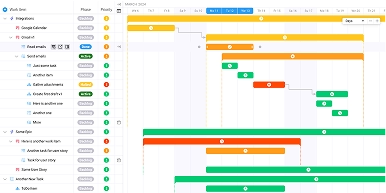
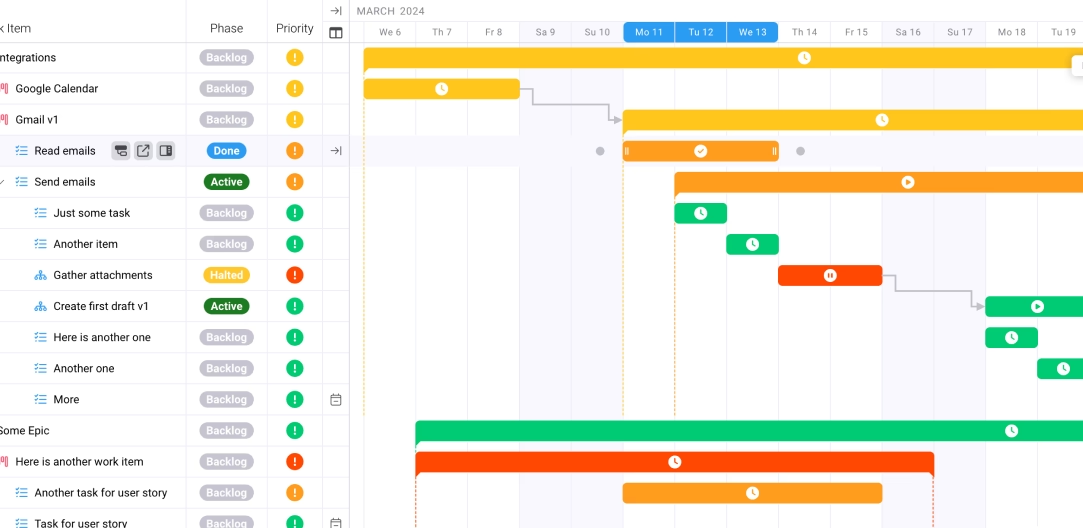
Data weight. One record carries an engagement from the CRM pipeline through the estimate, the project budget, logged hours, and the invoice. Retainers are tracked in both hours and dollars. Client asks arrive through request forms instead of inboxes. Work can be planned as a Gantt schedule or on agile boards, so a fixed-fee diagnostic and a sprint-based implementation don't need separate tools. G2 lists the product in both its project management and professional services automation categories, which is a fair summary of what it is.
Setup and admin weight. Onboarding is tailored to the firm and included in the subscription, and so is support. Reviewers back this up. On Capterra, a senior project manager who moved an agency onto Ravetree in early 2026 singled out fast support and a smooth onboarding, and a head of operations at another agency described the Ravetree team making adjustments overnight during implementation so the business could keep running through the switch.
Entry weight and adoption. The recurring theme in positive reviews is that people actually use the thing. A principal at a training and coaching firm wrote that a previous all-purpose work app had so many options the team found it confusing, while Ravetree's Gantt charts, time tracking, and billing were easy to pick up. On SourceForge, a president and COO at a company of fewer than 25 people said that after three other platforms that were either too generic or too confusing, internal adoption noticeably improved. The president of a 35-person agency put it another way: general enough for most firms, but closely fitted to the quirks of a mid-sized shop.
If you'd like to see a complete engagement run through the platform, Ravetree's guide to PSA software for boutique consulting firms follows one from estimate to retainer, and its roundup of work management software for consulting firms compares the wider categories.
Where it isn't the pick
A solo advisor billing one client doesn't need a PSA; a timer and an accounting app will do. And a firm of several hundred people with a global ERP, multiple legal entities, and a dedicated systems team may want an enterprise suite with deeper customization. Ravetree is built for the firms in between, which is precisely the 10 to 50 band.
Roll It Out Light: Switch Features On When a Problem Asks for Them
Even a lightweight PSA tool feels heavy if you switch everything on in week one. A better approach for a small firm is to let problems pull features in, rather than pushing the whole platform out at once. Calendar-based rollout plans assume every firm hurts in the same order. Yours probably doesn't.
- Week one: projects, time, and invoicing only. These touch revenue directly, and within a month they give you clean baseline numbers on hours, budgets, and billing lag.
- Turn on staffing the second time two partners collide over the same consultant. The first collision is bad luck. The second is a pattern.
- Open the client portal and request forms when status emails start eating partner time, or when a client's "quick asks" begin showing up as unbilled hours.
- Move the pipeline and estimates in once you catch someone rebuilding a quote from scratch. That's the signal that history stored in the system has become worth more than the habit of starting fresh.
Then do three unglamorous things: name one owner, set a cutover date for the old tools, and explain the reason for the change in a sentence everyone understands. At 25 people, that's most of what change management means, and it matters more than the software. Prosci's long-running benchmarking research found that 88% of projects with excellent change management met or exceeded their objectives, making them roughly seven times more likely to succeed than projects with poor change management. Those were mostly larger initiatives, but the principle scales down neatly: people adopt what they understand and what someone visibly owns.
Pick the Tool Your Firm Can Carry
A 10 to 50 person consultancy rarely fails at software because it bought too few features. It fails because it bought weight it couldn't carry: setup it never finished, admin nobody owned, timesheets nobody liked. Judge every platform on those terms. Run the seven trial tests, do the seat math at 50, and count the hours the system asks of your people, not just the dollars it asks of your budget.
On those measures, Ravetree comes out ahead. It covers the full engagement in one system, prices simply, and gets used by the people who have to feed it. If you're choosing the Best Lightweight PSA Tool for 10 to 50 Person Consultancy growth, start a trial, load one real engagement, and see whether it passes. Our bet is that it's the lightweight PSA tool most firms in this range will still be glad they chose when they reach 50.
Frequently Asked Questions
What makes a PSA tool "lightweight"?
It's the ongoing effort the software demands, not the length of its feature list. A lightweight PSA tool can be set up in weeks, maintained by a generalist in a couple of hours a week, and used by consultants without adding meaningful time to their day.
At what headcount does a consultancy need PSA software?
Most firms feel the need somewhere between 15 and 25 people, when staffing stops fitting in one partner's head and billing starts slipping. Buying before that point is fine if the tool lets you start with time, projects, and invoicing and add the rest later.
How much should a 30-person consultancy expect to pay?
Pricing varies widely, so get a quote at both 30 and 50 seats. At Ravetree's published annual rate, 30 users come to about $10,440 a year. The bigger cost to watch is internal admin time, which can easily exceed the license.
Can a firm outgrow a lightweight PSA tool?
Yes, usually somewhere in the hundreds of employees, once you add multiple legal entities, complex revenue recognition, or an ERP that the PSA must feed. For firms between 10 and 50 people, that ceiling is a long way off.